
Introduction
An FBR notice landing in your IRIS inbox triggers one of two instincts — panic and pay, or ignore and hope. Both are mistakes that cost real money. The Income Tax Ordinance, 2001, together with the 2025–26 enforcement amendments, gives FBR considerable teeth against non-responsive or poorly-responded taxpayers: ex-parte orders, penalty accumulation, and Active Taxpayer List consequences that raise your withholding rates across the board.
The good news: a properly structured response resolves the overwhelming majority of notices without escalation. This guide walks through exactly how to build that response — what goes first, what goes second, and how to avoid the mistakes that turn a routine query into a prolonged dispute.
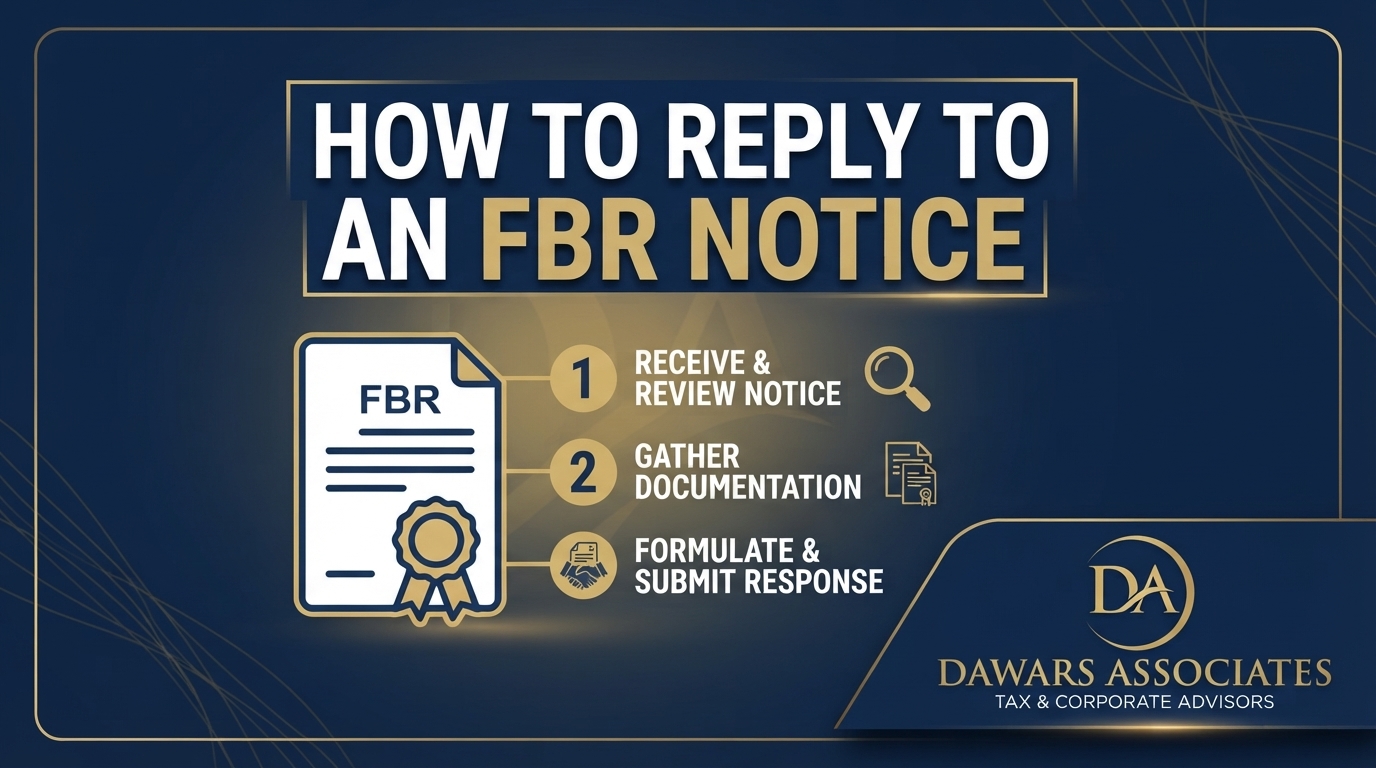
Step One: Verify and Understand the Notice
Before drafting anything, confirm the notice is genuine. Log into IRIS, check “Notices Received,” and match the reference number. FBR does not demand payment by phone call or WhatsApp — treat anything arriving only that way with suspicion until verified on IRIS.
Once confirmed, identify three things:
- The section it’s issued under — 114 (non-filer), 122(5A) (proposed amendment), 176 (call for information), 177 (audit selection), 161 (withholding audit), 111 (unexplained income), among others
- The statutory deadline — typically 10–14 days for show-cause notices, up to 30 days for assessment notices
- What is actually being alleged — a data mismatch, an audit selection, an unexplained asset, or a proposed disallowance
Each notice type needs a different response shape. A Section 176 call for information needs documents, not arguments. A Section 122(5A) amendment proposal needs both facts and law. A Section 111 notice needs a reconstructed money trail. Knowing which one you’re dealing with shapes everything that follows.
Step Two: Build the Response — Facts First, Law Second
This is where most self-drafted replies go wrong — they either argue law with no facts behind it, or dump documents with no framing to explain why they matter. The correct order is deliberate:
1. Factual points, always first.
Before any legal argument, give the officer a clean, sequential account of what happened: the transaction, the source of funds, the expense and its business purpose — each one supported by a dated, numbered exhibit. Address every disputed item separately rather than covering everything in one narrative paragraph. Responses that pair each allegation with its own exhibit consistently resolve faster and more favourably than a single sweeping explanation.
2. Legal points, only where facts alone won’t settle it.
This includes:
- Limitation — is the notice within the time period permitted under the relevant section?
- Jurisdiction — is this the correct Commissioner or forum?
- Relevant Tribunal or High Court precedent on the same point
- Procedural defects in the notice itself — vague allegations, missing reasons, denial of proper opportunity of hearing
A response built entirely on legal technicalities with no factual explanation tends to invite deeper scrutiny — it reads as an admission the facts don’t hold up. A response built entirely on facts, ignoring a genuine limitation or jurisdictional defect, gives up a defence you were entitled to raise. Use both, in that order, and only bring in law where it’s actually doing work.
3. A specific, clear prayer.
End with exactly what you’re asking the officer to do — drop the proceedings, accept the declared amount, allow specific expenses. A response that ends without a clear ask leaves the officer to interpret your intent, which rarely works in your favour.
4. Keep your own file.
Retain a copy of every submission, exhibit, and IRIS confirmation permanently. If FBR later disputes what was filed or when, this is your only proof.
Step Three: Manage Your Time Properly — Don’t Let a Late Start Force a Rushed Response
Sometimes the notice sits unread for a while — a client forwards it late, or it’s discovered only when checking IRIS for something else. If that happens to you, the instinct is often to panic and file something, anything, before the deadline. Resist that instinct. A rushed, incomplete response is worse than a short, well-justified delay.
If you’re genuinely short on time to gather the exhibits your case needs, an adjournment request is a legitimate procedural tool — not a sign of weakness. File it before the deadline, state a specific and credible reason (third-party documents in progress, foreign remittance confirmations pending, records being compiled), and use the additional time to actually complete the response properly. One well-justified adjournment, filed early with a concrete reason, rarely damages a case.
What does damage a case is treating adjournment as a substitute for preparation — vague requests, repeated extensions with no new documents to show for them, or asking for more time with no real plan for what happens next. The point of extra time is always to file a stronger, complete response — not to delay indefinitely.
Common Mistakes That Weaken a Response
- Responding to the wrong allegation because the notice wasn’t read carefully enough before drafting
- Submitting documents with no narrative explaining what they prove
- Filing at the very last hour, leaving no room to fix gaps the officer might flag
- Not keeping copies of what was actually submitted
- Attempting Section 111 or full audit notices without professional guidance — these involve documentation and procedural steps that genuinely benefit from experienced handling
What Happens If You Don’t Respond Properly
A missed deadline — or a response so weak it’s effectively no response — converts a resolvable notice into an ex-parte order, where FBR decides based only on its own information. From there, your only route is appeal under Section 127 before the Commissioner (Appeals), within 30 days of the order: longer, costlier, and less certain than answering the original notice properly would have been.
The Bottom Line
A well-handled FBR notice is not about speed or about aggression — it’s about sequence: verify it, understand exactly what’s being asked, lead with organized facts, bring in law only where it earns its place, and ask for something specific. If time is tight, take the extra days properly rather than filing something incomplete under pressure. Handled this way, most notices resolve at this stage and never need to go further.
Dawars Associates regularly represents clients before Inland Revenue officers on Section 111, 122, 161, and 177 matters. If you’ve received an FBR notice and are unsure how to respond, reach out before the deadline — not after.

